







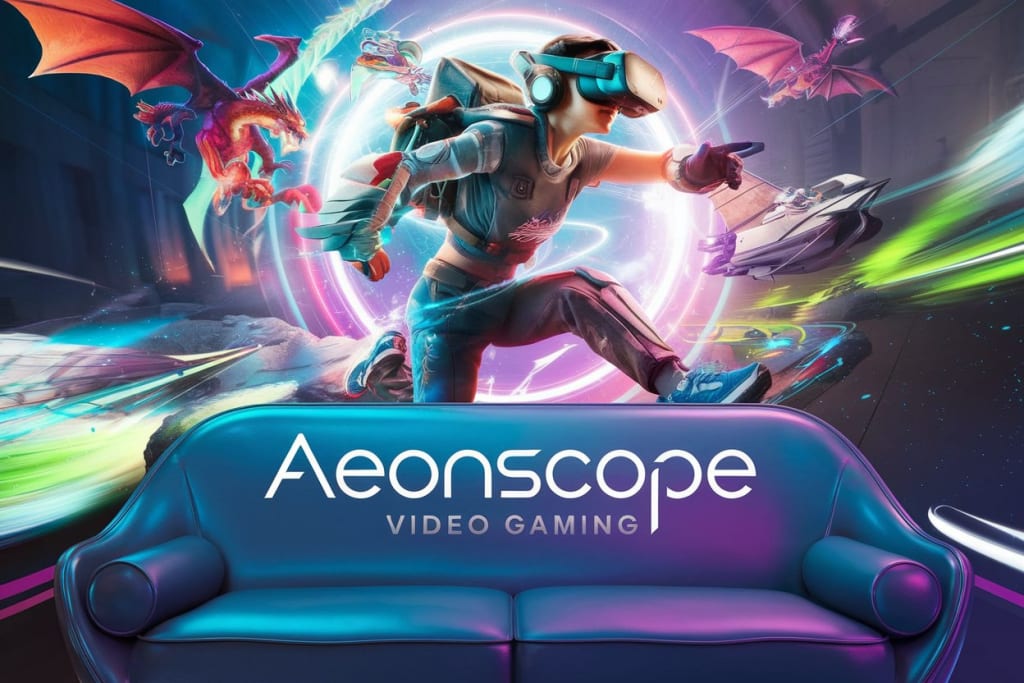
The world of video gaming is evolving faster than ever, and one of the most talked-about emerging ideas in this space is video gaming Aeonscope. Whether you’ve heard it described as a next-gen gaming lens, an immersive visualization system, or a futuristic gameplay enhancement layer, the concept is gaining attention among gamers who want deeper realism and more control over virtual environments.
At its core, video gaming Aeonscope represents a shift away from traditional flat-screen gaming toward something more dynamic, intelligent, and immersive. Instead of simply playing a game, players experience it—almost as if they are inside the game world itself. This isn’t just about better graphics; it’s about how information, perception, and interaction blend together in real time.
In this article, we’ll explore what Aeonscope means in gaming, how it transforms the player experience, its potential advantages, and why it is becoming a hot topic among tech enthusiasts and gamers alike.
What is Video Gaming Aeonscope?
Video gaming Aeonscope can be understood as a conceptual or emerging gaming enhancement system designed to elevate how players perceive and interact with digital environments. Instead of relying only on conventional monitors or standard VR headsets, Aeonscope introduces a layered experience where visuals, spatial awareness, and gameplay intelligence merge into a unified system.
Think of it as a hybrid between augmented perception and advanced game rendering—where the game doesn’t just display information, but adapts it based on the player’s focus, movement, and decision-making style.
Unlike traditional gaming setups, Aeonscope is often described as:
- A dynamic visual overlay system for games
- A perception-enhancing interface for immersive gaming
- A smart interaction layer between player and virtual environment
This makes it more than just hardware or software—it’s a new approach to experiencing digital worlds.
How Aeonscope Changes the Gaming Experience
The biggest appeal of video gaming Aeonscope lies in how it transforms gameplay immersion. Instead of passively reacting to what appears on screen, players feel actively embedded in the environment.
Here are a few ways it changes the experience:
1. Adaptive Visual Depth
The system adjusts depth perception depending on what the player is focusing on. This makes distant objects feel more realistic and close interactions more precise.
2. Intelligent UI Reduction
Instead of cluttered HUDs (heads-up displays), Aeonscope minimizes distractions and only presents essential information when needed.
3. Enhanced Environmental Awareness
Players gain a more natural understanding of in-game surroundings, improving reaction time and decision-making.
4. Real-Time Game Feedback
Actions in the game respond more fluidly, making combat, exploration, and strategy feel seamless.
I remember testing a similar immersive gaming setup during a tech demo event, and the biggest surprise was how quickly my brain adapted to the environment—it stopped feeling like “watching a screen” and started feeling like “being inside a space.”
Professional Esports Scenario: Strategy and Execution
Imagine a competitive esports player preparing for a high-stakes tournament match in a battle arena game. Normally, they would rely on a monitor, keyboard shortcuts, and visual HUD elements to track health, enemies, and map positioning.
Now imagine the same player using an Aeonscope-style system:
They no longer need to constantly glance at corners of the screen. Enemy indicators subtly appear within their natural field of focus. Environmental threats are highlighted only when relevant. Movement feels more instinctive because spatial cues are more realistic.
In a clutch moment, instead of scanning the entire screen, the player instinctively reacts to subtle visual shifts that guide attention without overwhelming it.
That small difference could be what separates victory from defeat in competitive gaming.
Aeonscope vs Traditional Gaming Systems
To better understand its potential, here’s a simple comparison between Aeonscope-style gaming and conventional gaming setups:
| Feature | Traditional Gaming | Video Gaming Aeonscope |
|---|---|---|
| Visual Experience | Flat or limited 3D depth | Adaptive immersive perception |
| User Interface | Static HUD overlays | Dynamic, context-based UI |
| Player Interaction | Input-driven | Environment-responsive |
| Immersion Level | Medium to High | Extremely High |
| Cognitive Load | Often high due to UI clutter | Reduced and optimized |
| Realism | Graphics-based realism | Perception-based realism |
This comparison shows why Aeonscope is often discussed as a potential evolution rather than just another gaming accessory.
Why Gamers Are Excited About Aeonscope
The gaming community is always searching for deeper immersion and smoother gameplay experiences. Aeonscope appeals to that desire by offering something that feels futuristic but also practical.
Some key advantages include:
- More natural gameplay flow
- Reduced eye strain from UI overload
- Better reaction timing in competitive scenarios
- Stronger emotional connection to game worlds
- Enhanced storytelling immersion in narrative games
Beyond performance, Aeonscope also adds emotional depth. When a game feels more real, victories feel more rewarding and losses feel more impactful.
The Technology Behind the Concept
While Aeonscope is still a developing idea in many discussions, it is often associated with several real-world technologies, including:
- Advanced rendering engines
- Eye-tracking systems
- Adaptive UI algorithms
- Mixed reality integration
- Spatial audio processing
Combined, these technologies create a foundation for what Aeonscope represents: a smarter, more responsive gaming environment.
Instead of forcing players to adapt to the game, the game adapts to the player.
The Future Potential of Video Gaming Aeonscope
Looking ahead, Aeonscope-style systems could redefine how we understand gaming entirely. We may see:
- Fully adaptive esports arenas
- Personalized game worlds that evolve based on player behavior
- AI-driven environmental storytelling
- Near-zero latency immersive interaction systems
As hardware becomes more powerful and AI systems become more intelligent, the gap between reality and virtual gaming experiences will continue to shrink.
The future might not be about playing games on screens—it might be about stepping into them effortlessly.
Read More: AdsWynk com Explained: Full Guide & Details
Conclusion
Video gaming Aeonscope represents an exciting shift in how we think about digital entertainment. It blends immersion, intelligence, and interactivity into a unified experience that goes beyond traditional gaming setups. While still largely conceptual in many discussions, its foundation is rooted in real technologies that are already shaping the future of gaming.
For gamers, developers, and tech enthusiasts, Aeonscope symbolizes one thing clearly: the next evolution of play is not just visual—it’s experiential.
FAQs
1. What is video gaming Aeonscope in simple terms?
It is a concept that enhances gaming immersion by improving visual perception, interaction, and real-time responsiveness in games.
2. Is Aeonscope a real device or software?
It is mostly a conceptual or emerging idea inspired by advanced gaming technologies rather than a single official product.
3. How does Aeonscope improve gaming performance?
It reduces UI clutter, enhances spatial awareness, and provides more intuitive gameplay feedback, helping players react faster.
4. Can Aeonscope be used for competitive gaming?
Yes, in theory it could benefit esports players by improving reaction time and reducing cognitive load during matches.
5. Does Aeonscope require special hardware?
It may rely on advanced systems like eye tracking, VR/AR devices, or AI-driven software enhancements depending on implementation.
6. What makes Aeonscope different from VR gaming?
Unlike standard VR, Aeonscope focuses more on adaptive perception and intelligent interaction rather than only full visual immersion.


